RETAIL
Choose the evolution in retail
Find out how we can help you create new in-store experiences that win over consumers and add value to your brand.


Today we use smartphones to shop, book trips, stay informed and, more recently, also to order meals to enjoy at home thanks to the many mobile apps available on the market. To remain competitive, traditional restaurants need to evolve and integrate the dynamics of digital interaction within their venues.
The evolution of the Ho.Re.Ca. world does not only concern international markets but also involves Italy, where tradition and innovation find a balance. Whether it is a small family-run restaurant or a large international chain, digital transformation represents both a challenge and an opportunity.
Self-ordering systems and contactless payments, entertainment areas, and tools for analyzing customer behavior and satisfaction are redefining the way guests interact with restaurants, reducing waiting times and improving overall efficiency.
Digital sustainability is also playing a key role: more and more restaurants are adopting eco-friendly solutions, such as eliminating paper through the use of digital receipts and low-energy devices. Not to mention restaurant management systems — a constantly growing market with dedicated software designed to optimize restaurant workflows, manage orders, table reservations, and all accounting and administrative aspects related to receipts and payments.
Digital Menu Boards are systems that integrate displays used to present a restaurant’s offerings: dish prices, descriptions, images, videos, and available promotions. When interactive, they also allow customers to choose and customize their meals.
Today it is increasingly common for interactive digital menus to integrate self-ordering systems, enabling users to independently select dishes from the digital menu and proceed with payment either through their smartphone or directly at the restaurant’s checkout.
It is no coincidence that major restaurant chains in Italy and around the world are installing Self-Ordering Kiosks equipped with so-called self-ordering terminals—automated ordering and payment systems capable of communicating directly with the restaurant’s management software platform.
The benefits of integrating digital menus in restaurants can be summarized into four main aspects:
Today’s customers are hungry for information: they want to know the origin of a dish, how it is prepared, its ingredients, health benefits, and caloric content. This large amount of information often cannot fit on printed menus.
Digital Menu Boards offer greater flexibility: they are easy to update and can display rotating content without space limitations. Through QR codes, customers can access detailed information about dishes and much more—such as current special promotions and upcoming offers—encouraging them to return.
Digital menus suggest pairings between drinks and dishes, as well as additional items such as sauces or extra portions at discounted prices. Instead of consulting a printed menu or waiting for a server—perhaps when they are in a hurry to order—customers can view current offers directly on the digital display and calmly configure their meal.
This freedom of choice often leads customers to order something extra. The integration of self-ordering with self-payment tools also eliminates waiting times at the cashier, further encouraging customers to return.
All digital menus within the network can be centrally controlled. Through simple and intuitive dashboards, restaurants can upload new products, update prices, and add limited-time promotions. All changes can be synchronized across the restaurant’s digital stations, across an entire chain, or only in selected locations, depending on the restaurateur’s strategy.
This approach not only saves significant time and resources but also ensures full control over the brand image and the presentation of the restaurant’s offerings.
In general, statistics show that venues introducing a Digital Menu Board network experience increased profits for all the reasons mentioned above: more satisfied customers, a greater willingness to spend, and higher return rates.
A major source of savings comes from eliminating the need to print, reprint, display, and remove physical materials every time prices, menus, or promotions change. 💡📈


The digitalization of a restaurant is a key factor in attracting and retaining an increasingly demanding clientele. It helps respond to new consumption habits and, indirectly, generates new revenue opportunities.
A restaurant is not merely a “food service station” where people quickly eat and leave; it is a place for social interaction and sharing. For this reason, several international restaurant chains are focusing on so-called Family-Fun Play Areas—digital entertainment zones that combine technology with social interaction and shared experiences.
The name Family-Fun Play Area can be misleading. Although it might suggest digital corners designed mainly for families with children, in reality these spaces are much more than that and are aimed at a broad range of consumers.
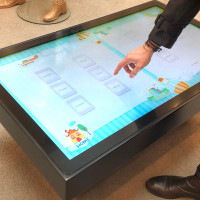
These areas typically include interactive tables and touchscreen displays dedicated to digital entertainment for children, teenagers, and adults alike.
Multimedia systems in these spaces usually integrate multi-touch and multi-user gaming platforms, featuring interactive games with educational, creative, social, or competitive elements.
In this context, technology acts as a tool to bring people together rather than isolate them.


Why Every Restaurant Should Have a Family-Fun Play Area The reasons are clear:
Interactive tables and multi-touch displays, equipped with dedicated software, make mealtime engaging and enjoyable, encouraging customers to stay longer and, consequently, consume more. These systems also allow the presentation of other multimedia content, promoting the restaurant brand, partners, or special offers. Waiting for a meal is no longer a nuisance when you can spend that time having fun with fellow diners.
Interactive solutions in Family-Fun Play Areas can boost brand awareness and create a direct dialogue with customers. By tracking user habits and preferences, restaurants can tailor the entertainment experience, ensuring guests are continually satisfied and engaged.
Family-Fun Play Areas offer experiences that, while embracing digitalization, foster social interaction and shared moments. Recent studies show that over 70% of young people still prefer physical spaces over virtual ones to spend time with friends. These areas, designed for conviviality and engagement, help keep customers in the restaurant longer, representing a promising new avenue for investment and revenue.


Digital transformation is now an unstoppable process across all sectors—from industry to tourism, retail, and services. Failing to embrace this change could mean being left behind in the medium to long term.
In the restaurant sector, digitalization is not just a trend—it is a necessity. In an increasingly competitive market, restaurateurs must respond quickly and effectively to rising customer expectations while optimizing their operations.
Discover a success story: McDonald’s Italy Family Corners Italy
A Digital Menu Board is the evolution of the traditional printed menu, presented in a digital format.
Displayed via interactive screens or Digital Signage systems, it showcases the restaurant's food offerings. The Digital Menu Board can integrate QR Code systems that expand the content available to customers, enhancing customer engagement with information such as ingredients, calorie intake, the story behind a dish, and more.
Self-ordering systems, often combined with self-payment features, allow customers to place orders quickly and independently, encouraging them to order more.
When paired with self-payment, customers can also complete their payment without waiting for a waiter or standing in line, saving valuable time for both staff and guests.
Indirectly, these systems also significantly reduce staffing costs, as fewer waiters are needed in the dining area.
Yes, it has been widely proven that the entire ecosystem of digital restaurant solutions – from self-ordering kiosks to industry-specific management software, and even Family Areas designed for entertainment – helps restaurants reach more customers, increase revenue, and ultimately boost sales.
Digital solutions allow restaurants to reach a wider and more diverse audience, build customer loyalty, and gather valuable data through integrated analytics tools to personalize offerings and marketing strategies.
Digital menu content is easily managed through a dashboard accessible from any device (desktop, laptop, smartphone) or via a web interface.
Using a user-friendly visual control panel, restaurants can:
Upload all types of content they want to display to customers
Select which devices to publish content on (e.g., for chains with multiple locations and varying menus/offers/ads)
Schedule publication timing
Decide if and when to activate specific interactive content
Family-Fun Play Areas are high-entertainment digital corners typically found in restaurants, cafés, and shopping malls. They feature multi-user interactive solutions equipped with specially developed entertainment software: gaming platforms with interactive game suites designed to develop cognitive, logical, and problem-solving skills, as well as apps for reading newspapers and more.
These areas often include promotional and advertising messages from the venue and can also integrate self-ordering and payment systems.
No. Although the name may suggest they are only for younger audiences, Family-Fun Play Areas are designed for all potential customers. The restaurant can tailor its digital offering based on its target audience. For example, it can load games suitable for different age groups or choose the types of newspapers, magazines, and comic books available for reading.
The main advantage of Family-Fun Play Areas lies in the ability to diversify the restaurant’s entertainment and communication offerings, enhancing its marketing strategy.
Yes. Technology and digital solutions are universal. Digitalization is no longer just a trend—it’s an opportunity for all restaurateurs to improve operations, optimize management, and deliver a more personalized and engaging customer experience.
Both Digital Menu Boards and Family-Fun Play Areas can be customized in terms of size (to fit the physical space), placement, and content.
Restaurants of all sizes—from small, family-run establishments to large international chains—can benefit from the advantages of digitalization.
Digitalization is not only compatible with sustainability—it increasingly represents a core element of the restaurant industry. The trend of "Restaurant 4.0" is all about combining technological innovation, sustainability, and energy efficiency.
A practical example of immediate sustainable action in the HoReCa sector is the digitalization of menus, which reduces paper waste and the costs associated with printed materials.
Another key factor in promoting sustainability is the adoption of digital receipts. Their use helps reduce paper and ink consumption and lessens the environmental impact related to the production and disposal of traditional receipts.
Finally, all the latest technologies used in Family-Fun Play Areas must be eco-friendly to be considered truly future-oriented—built with low CO2-impact materials and low energy consumption. It’s a perfect blend of innovation, sustainability, aesthetics, and design.
Find out how we can help you create new in-store experiences that win over consumers and add value to your brand.
Recreation areas for children, playgrounds where young guests can play and compete with one another.
Creating a digital entertainment area for children, where they can tackle new challenges and socialize.
A mix of innovation and technology, for a thrilling shopping experience.